

Ten years ago, the Merriam-Webster Dictionary declared “surreal” its word of the year. There were many reasons for its popularity that year. In the century since the 1924 publication of André Breton’s Manifeste du surréalisme, the movement known as Surrealism has been through its ups and downs. One thing remains constant: a desire to épater les bourgeois, one that continues to astonish even as the notions of what constitutes the bourgeoisie dissolve before our eyes. The terrific exhibition “International Surrealism from Tate: Fifty Years of Dreams,” which shows works selected from the Tate Gallery’s collection and presented at the Frist Art Museum in Nashville, takes a refreshingly wide view of Surrealism, reminding us that, while some artists were for a time companions, they soon moved far beyond the often-airless confines of what was initially an exhilarating but ultimately limited endeavor.
It is worth remembering that Surrealism was originally a literary movement, one, as Breton wrote, founded on “pure psychic automatism, by which one proposes to express—verbally, in writing, or in any other manner—the true function of thought, in the absence of control exerted by reason, and exempt from all aesthetic or moral concern.” In short order, Surrealist scribes were joined by visual artists, whose innovative techniques and idiosyncratic motifs made it easy to forget that startling imagery had not actually been a part of the movement’s origin story. Unlike the Impressionists and Cubists, the Surrealists never dictated any one style. Max Ernst’s grattage landscapes, Giorgio de Chirico’s enigmatic classical vistas, Salvador Dalí’s suavely disturbing dreamscapes, and Man Ray’s richly tonal rayographs illustrated what Breton called a “unification” of “interior reality and exterior reality” by reinterpreting painting, sculpture, and photography as new psychic states that blurred the boundaries of the conscious and the unconscious. As time went on, a new wave of mostly female Surrealists—Dorothea Tanning, Remedios Varo, Leonor Fini, Meret Oppenheim—introduced piquancy to Surrealism’s existing themes, especially those of sexuality, love, and desire.
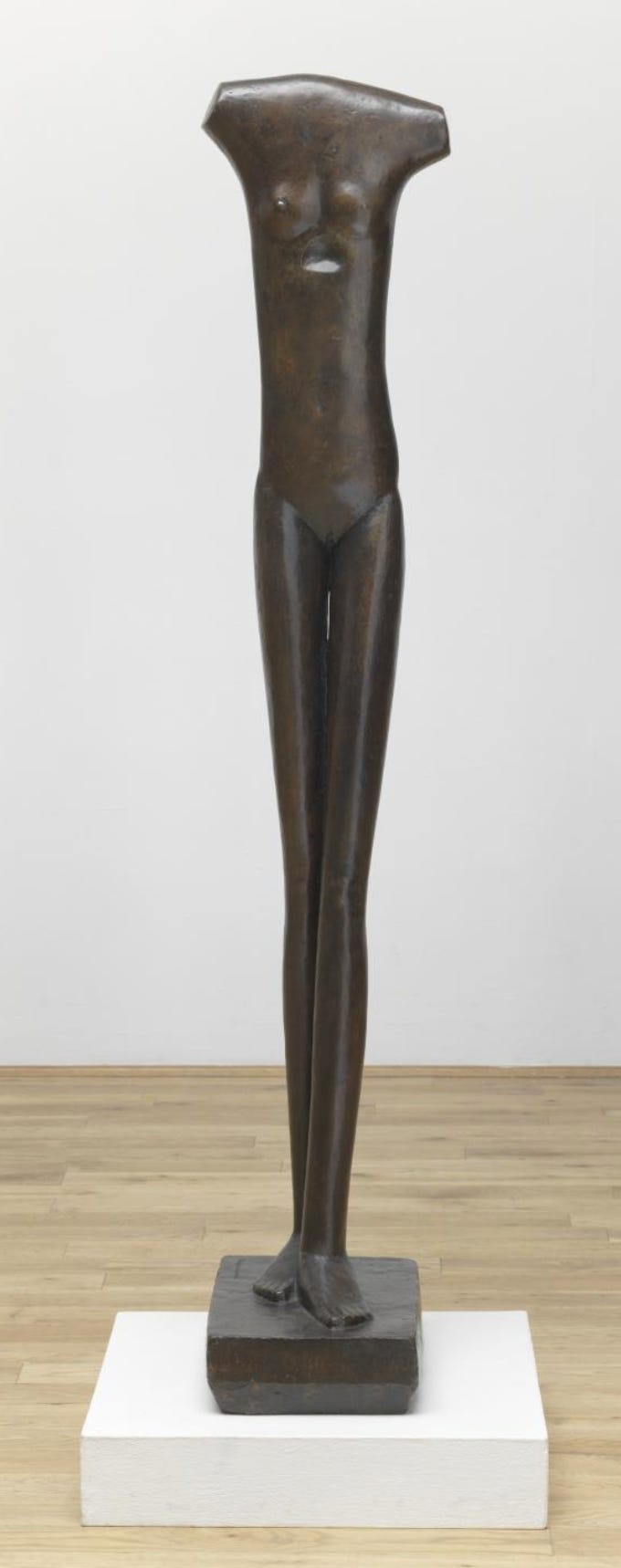
A small alcove at the Frist displays some remarkable sculptures testifying to the movement’s evolution, with two works by Alberto Giacometti, Walking Woman I (1932–36, cast 1996) and Composition (Man and Woman) (1927, cast 1964), and Louise Bourgeois’s Knife Couple (1949). The elongated, simplified form of Walking Woman prefigures Giacometti’s later interest in ancient representations of the body and explorations of bodies in space. But in his early career, Giacometti, who was invited by Breton to join the Surrealists in 1931, approached sculpture very differently. He initially created Walking Woman with a head and two arms that ended in “a bunch of feathers” and a “flower-like hand”; he later removed these but kept the hollowed-out space below the breasts. Composition (Man and Woman) is a deconstructed, Cubist affair in which two human figures have been broken apart and fitted back together in what looks similar to an engine block; later, Giacometti recast simplified bodies into works that Sartre described as “situated appearance.” Bourgeois—better known for her installations and suspended spiders—made Knife Couple as part of her series Personages, works representing loved ones she left behind when she moved to America from France in 1938. Human-sized and less confrontational than her later work, this pair of wooden totems manages, in the Tate’s words, to “combine loving affection with the implicit threat of cutting and violence.”
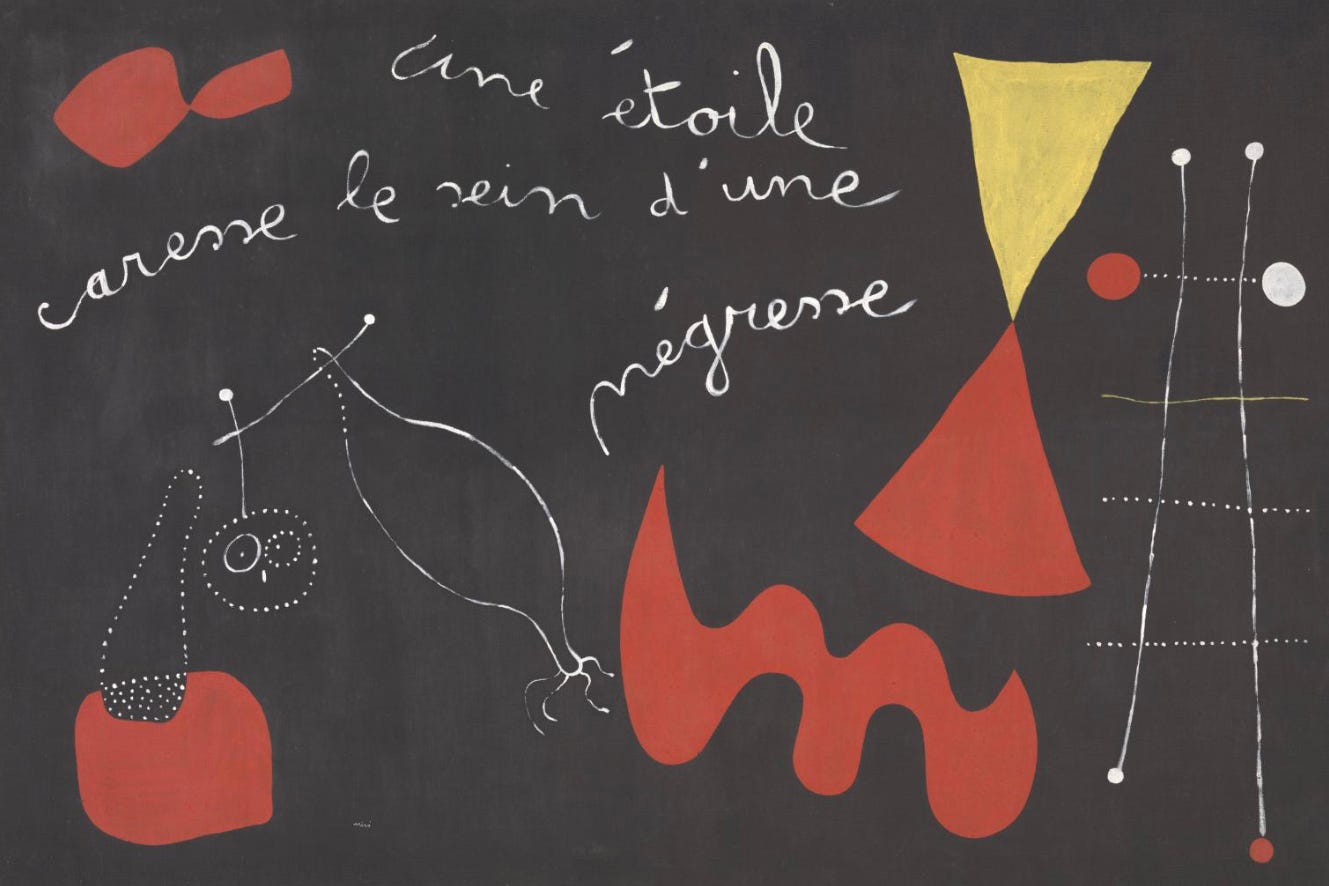
The Surrealists’ penchant for automatism and free-form gestures has evoked mixed responses. Joan Miró’s A Star Caresses the Breast of a Negress (Painting Poem) (1938) is an erotic visual poem rendered in primary colors, wavering text, a ladder to the stars, and the artist’s shorthand symbols for the female sex—all on a black background. It is a scintillating example of Miró’s deep engagement with the subconscious, but its whimsy has been marred by the curator’s stern reminder in the wall text that the use of the word “negress” is now considered offensive. The Hungarian painter Judit Reigl was a latecomer to Surrealism, but her Mass Writing (1961) pushes automatism further technically by rendering the painting in what appears to be the soak-stain method. Surreal in intention, its execution is purely expressionist, intense and powerful. Dorothea Tanning, “the shape-shifter” as the Tate calls her, is a beloved but strange figure even by Surrealist standards. The extraordinary painting A Mi-Voix (1958) works at two levels: on the surface, we see blurred, spinning figures, but metaphorically the work suggests gossip and half-whispers. Eine Kleine Nachtmusik (1943) portrays a creepy encounter in an anonymous hallway between two young girls and an oversized sunflower. Pincushion to Serve as Fetish (1965) is a stuffed object in black velvet, whalelike and bristling with straight pins. Of Pincushion, Tanning cryptically observed that “a fetish is something not exactly or always desirable in sculpture, being a superstitious if not actually shamanistic object.”
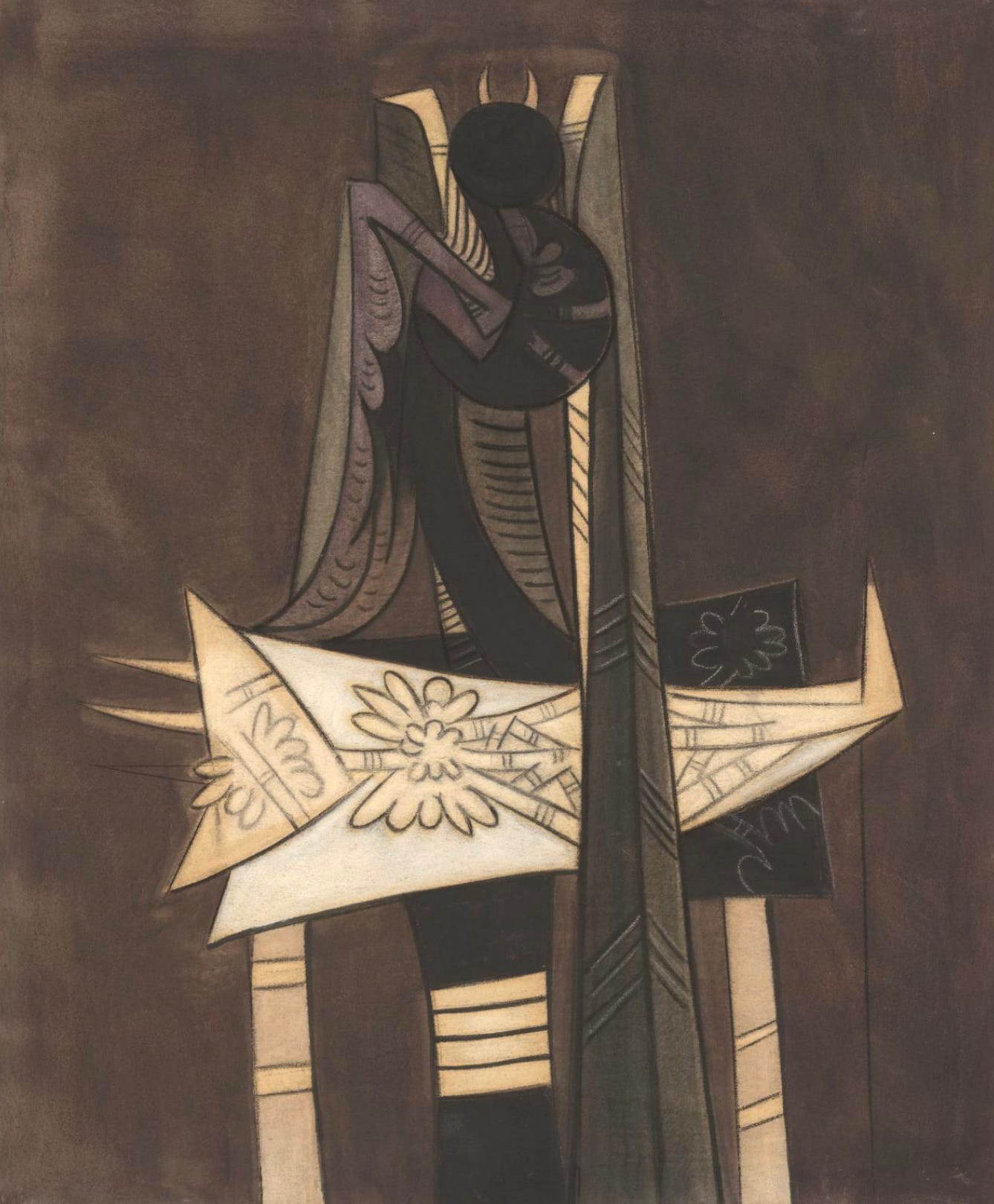
The exhibition’s emphasis on the international scope of Surrealism introduces lesser-known names among old favorites. I returned several times to Wifredo Lam’s Ibaye (1950), an unforgettable exposition of the Afro-Cuban artist’s inquiry into spirituality, witchcraft, and the natural world—is this painting simply about a mother and child or is it a stark commentary on war and social injustice? Krishna Reddy’s etching Three Graces (1958) is an astonishing intaglio print in which the artist used an experimental technique to depict the natural world at the surface level and the molecular level simultaneously. This richly textured image conjures up a startlingly fresh, abstract portrait of Euphrosyne, Aglaia, and Thalia. Malangatana Ngwenya’s Untitled (1967) is a Guernica-like tableau, drawn from incidents the artist witnessed during Mozambique’s War of Independence from Portugal (1964–74). Ngwenya, who spent eighteen months in prison for his involvement with the liberationists, offers an uncompromising view of man’s brutality in a tightly packed composition dominated by eyes, blood, teeth, and suffering.
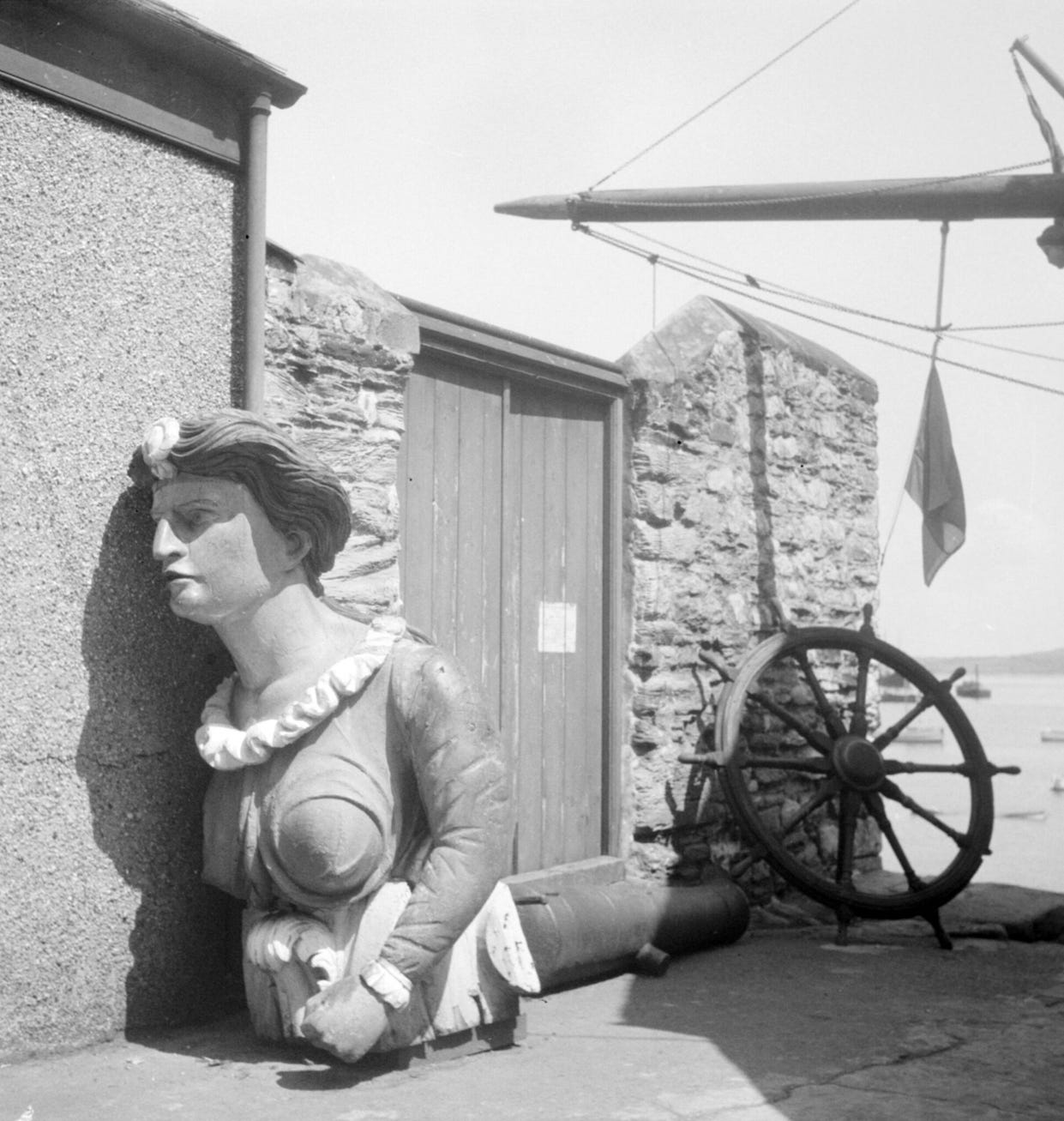
Photography was an especially fruitful medium for Surrealism, with its provocative blend of technology and aesthetic possibilities. The Mexican photographers Manuel and Lola Álvarez Bravo offered images that mixed expectations with the exigencies of reality, often abruptly. Lola’s photographs for her 1951 book Acapulco en el sueño invite us to join the beautiful people at Mexico’s glamorous resort town, while works such as Manuel’s Striking Worker Assassinated (1934) remind us that blood and death are never far below the surface. The Bravos’ photographs were influenced by the work of Walker Evans and Henri Cartier-Bresson, but Mexico’s often irreconcilable forces of shadow and light, peasants and jet-setters, and tradition and modernization gave their images a Surrealist edge. This exhibition also features several fine studies by the Argentine British painter and photographer Eileen Agar of massive boulders in Brittany and wonderful found juxtapositions such as Photograph of a Figurehead and a Wheel (1934).
Coming more than a century after Surrealism, this exhibition proves, if anyone was in doubt, that nothing is more surreal than reality itself. This is abundantly clear with Jean Arp’s Sculpture to Be Lost in the Forest (1932). Arp intended the charming biomorphic sculpture not to sit in a museum vitrine, but to be nestled in a spot in the forest near his home in France. The passerby could discover it by chance and wonder, as we now do, what these bronze shapes signify. Buds, pebbles—or something else altogether? Are they bonded together, or are they separate? Fate decreed something different for this artwork, whose acquisition was, according to the gallery label, “accepted by HM Government in lieu of tax and allocated to the Tate Gallery 1986.” A most unusual journey: from plaster cast to bronze to tax payment to museum curiosity. Arp, who believed that art should travel through the world lightly, melting or merging into other forms as needed, would no doubt have been delighted at this surreal turn of events.
This article is a co-publication with The New Criterion—Dispatch.