
Part 2: In Critical Condition
Salt and light

Thanks for coming back for the second part of my interview with Matthew J. Milliner, a professor of art history at Wheaton College. Last week, he and I talked about, among other things, his column for Comment Magazine which featured the essay “Art Haters Anonymous.” Check out Part 1 here if you want to read what we said on art, criticism, and the art critic’s obligation.
A Spectrum of Possibilities
Acroteria: I found your thoughts on the secularization of art as something that is on life support, maybe even collapsing, to be a source of optimism. Wouldn’t it be great if artistic pretensions to iconoclasm or polemics were retired in favor of a capacious and humble exploration of aesthetics, or as you once put it, “[exchanging] postmodern ennui for an impressive spectrum of possibilities.” What does this exchange look like and how does it affect how we might view controversial art?
Matt Milliner: I think it’s important to see that the good stuff is already happening. I refer to the “art world” for convenience, just as one might refer to “the University.” But there are in fact many micro-art worlds that are vastly more interesting than the mainstream, just as smaller projects of liberal arts renewal offset doomsday rhetoric about modern “education” at large. The key would be to identify such approaches and afford them the loving attention they deserve. Unfortunately, this is a costly endeavor, and not enough people are doing it, nor do they know where to look.
Return to Future Past
Acroteria: You have quoted Hegel who said “It is no help to adopt again…past world-views.” Surely, it is time for the art world pendulum to swing in the opposite direction, for art to return to “past world-views” of beauty and truth. How can we critics bring out these elements without sounding too Pollyanna-ish or earnest?
Matt Milliner: Yes, I’m resolutely un-Hegelian in that sense, and was citing him to suggest otherwise. I prefer my Christian mysticism served neat, undiluted. This entails abandoning a narrative of forward progress and instead appealing both downward to the contemplative depths and upward to the inbreaking of beauty at once. “In his hand are all the depths of the earth, and the heights of the hills are his also” (Psalm 95).
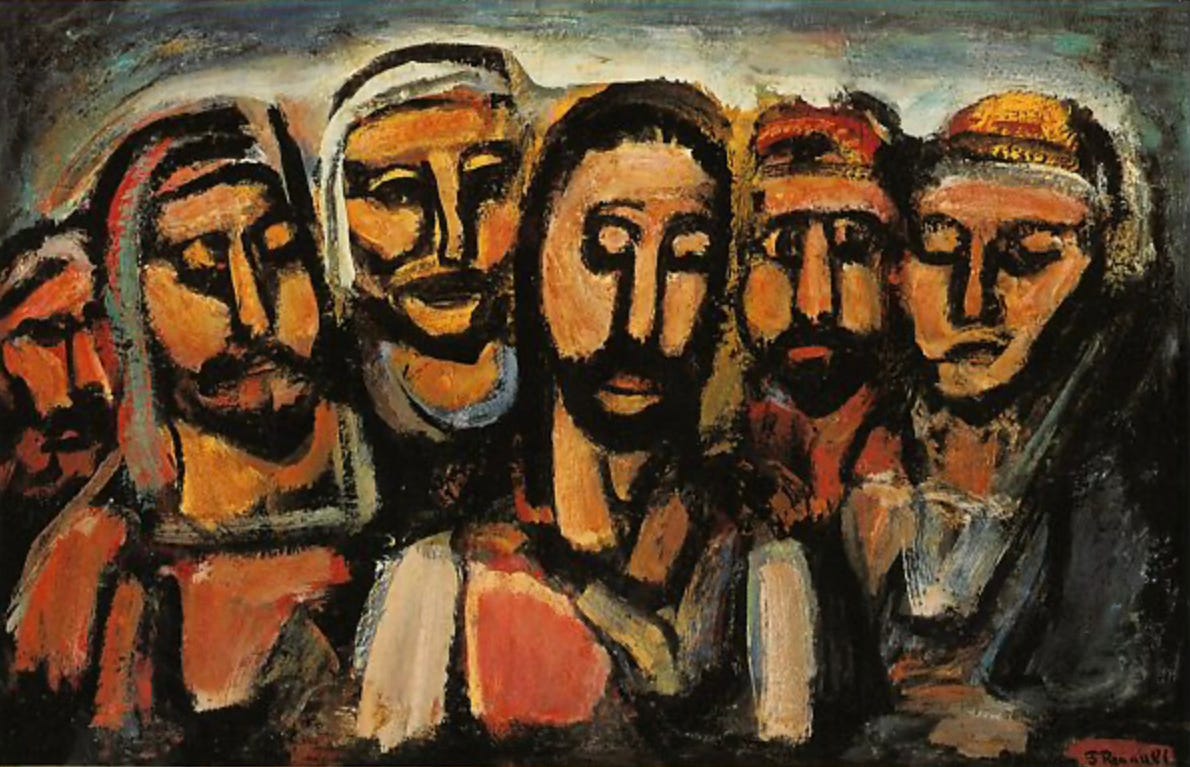
Of the forward momentum of Christian artists, I wrote this a while back: “[A]rtists of faith cannot expect to be admired. ‘A painter with real gifts,’ Clement Greenberg wrote of the twentieth-century Catholic artist Georges Rouault, ‘he fails to fulfill them because, among other things, he goes precisely to religion to find a pretext and justification for venting his abhorrence, not only of the epoch, but of humanity and himself.’ And yet it was Rouault, a man serious in both faith and art, who understood the way forward. ‘We can do something else,’ [Rouault] wrote, ‘but we cannot re-create what the collective, spontaneous effort of generations built with the faith that was theirs.’”
Surprised by Salt
Acroteria: One might see in your treatment of two different gallery experiences an evolution in your stance as a critic. On one hand, you recalled the work of Robert Gober whose installation in a Chelsea gallery “was arranged like a church, but with a trash can for a baptismal font.” Gober’s work often incorporates everyday objects and life-like body parts to interrogate themes of consumerism, the sacred, the bodily, and social issues. The installation was doubtless transgressive but it also struck the ironic tone that is de rigueur for contemporary artists who take on religious themes.
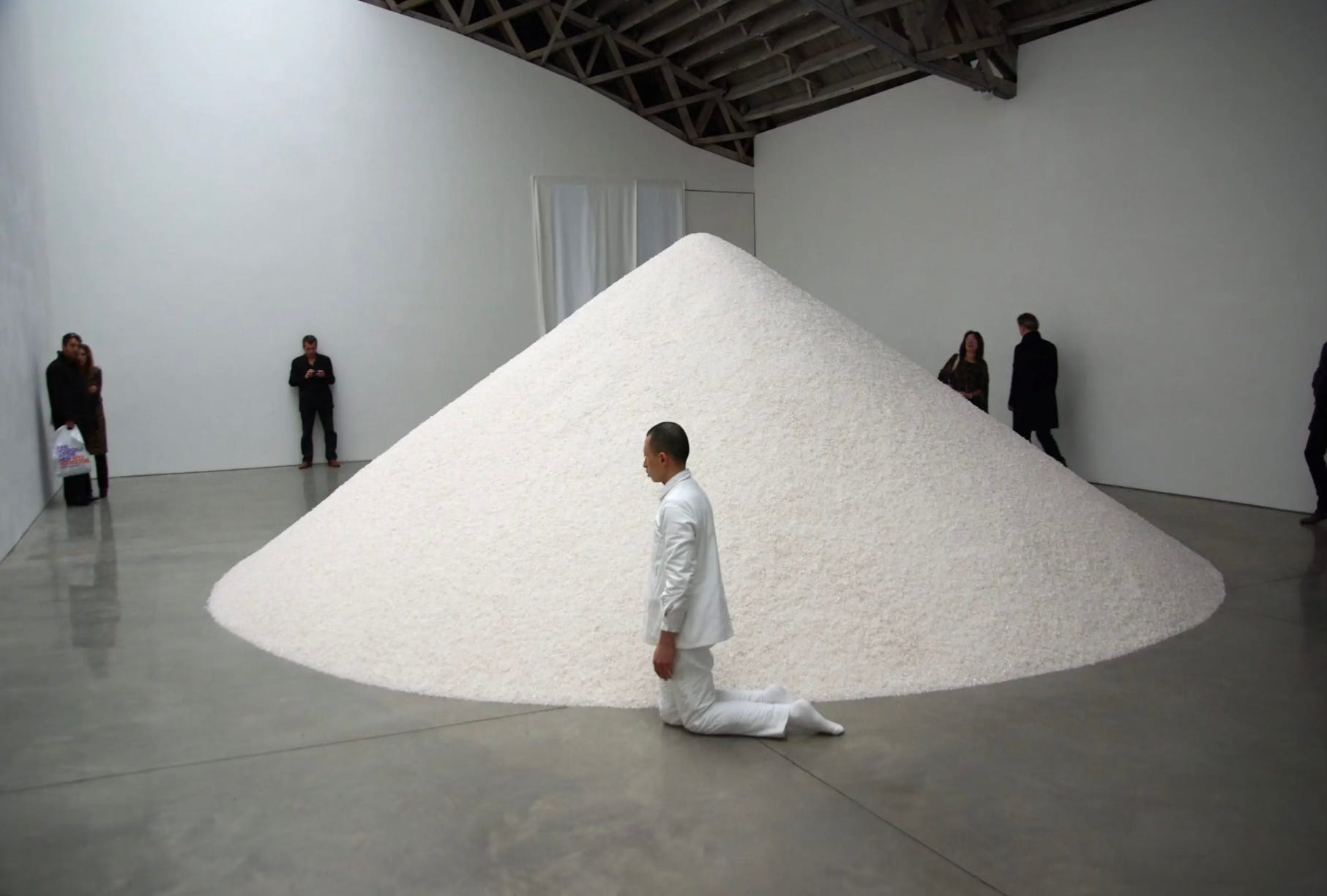
In contrast, you related seeing nothingtoodoo (eliade) by performance artist Terence Koh in New York. What you first thought of as “meaningless theatrics” quickly evolved into a more nuanced response. You wrote that Koh may have been seeking to resacralize silence in a noisy world, and that his act of circumambulating a huge pile of salt on his knees was really an act of prayer. Can you say a bit about art’s role in making meaning and where it succeeds and where it falls short?
Matt Milliner: Gober was, and is, lamenting, and looking back on that review, I think I might have had more compassion for that, seeing the gallery as an appropriate space in which to work things out. God has been handling such complaints ever since the Psalms. And a baptismal font is far worse than a trash can—it is my tomb (Rom. 6:4). I’m therefore not sure it’s blasphemous. As T.S. Eliot said, actual blasphemy is in fact quite rare, as it requires real faith that is then robustly, forcefully, and intelligently repudiated. Most people don’t ever really arrive at the necessary prerequisite of properly understanding the Christian faith with their adult consciousness in the first place.
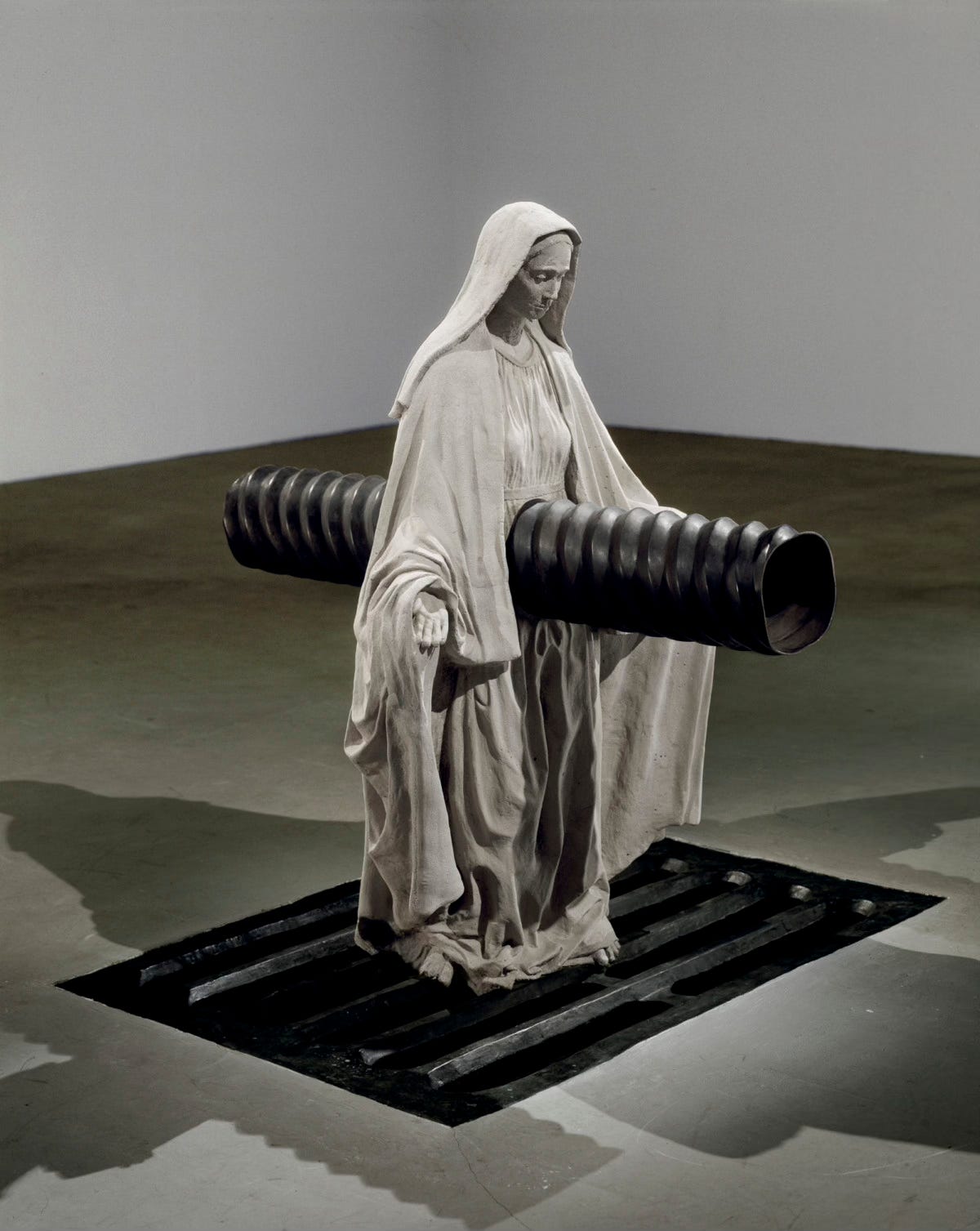
A functioning church, however, in my view is not the place to work those things out, hence my objection to what I considered to be a misplaced invitation to include Gober’s installation in an active Christian worship space. Churches that increasingly surrender their space to artists for whatever reason, sometimes sell the mess of “relevant” pottage for their eucharistic birthright. Inviting artists to contribute well to the construction of sacred space is in fact very difficult. It requires engaged clergy with theological and liturgical confidence, and artists who combine creativity and skill with sensitivity and humility. This convergence is exceedingly rare. The entropy of the religious status quo and the cult of artistic autonomy (or worse) frequently make cooperation impossible. But God help those who try.