
Part 1: Inside Out
Self-Portraits and Portraits of the Self


There are self-portraits and there are portraits that depict the self. In the case of the latter, I am referring to portrayals of a person, not necessarily the artist, that say as much about the subject’s inner life as his or her outer life. In fact, few portraits, self or otherwise, are objective; even in the case of official portraits, what the artist brings to the sitter’s depiction is personal and unique. In the modern age, portraits took on a psychological depth that tells as much about the artist as the subject.
Albrecht Dürer: Two Selves
One of eighteen children (only three reached adulthood), Albrecht Dürer was one of the most gifted artists of the Renaissance, technically expert and psychologically probing in his many paintings, drawings, and engravings. He revolutionized printmaking taking it from a commercial art (one already practiced at a high level by his peers ) to an artform in and of itself. Precociously talented, Dürer began drawing as a young boy and, by his twenties, had mastered the art of wood engraving and painting. A trip to Italy introduced this German Gothic master to Renaissance ideas such as the rediscovery of classical art, the vibrancy of Venetian colors, and the concept of individuality and subjectivity in art.
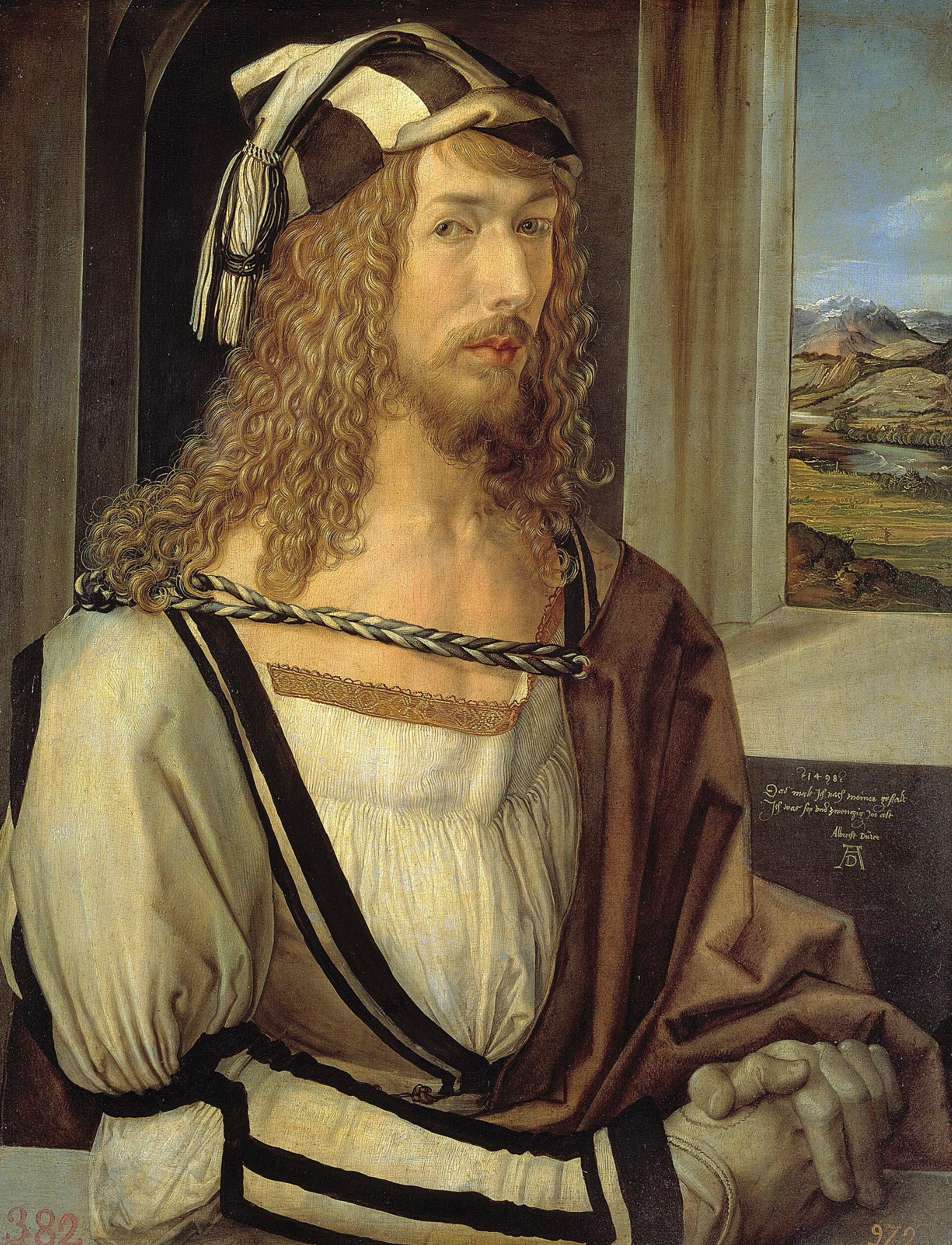
Dürer exhibits particularly the latter in these two self-portraits. Self-Portrait at 26 was completed in 1498 after his first trip to Italy. To our eyes, Dürer might look like a bit of a fop, but, at the time, this portrayal would have introduced viewers to the artist as he wished himself to be perceived by the public. His youthful appearance and striking clothing, made of the finest materials, emphasize his precocity. The painting’s inscription—“I have thus painted myself. I was 26 years old. Albrecht Dürer”—declares the artist’s desire to record a singular moment in his life, a time when he looked a certain way and adopted a particular persona. He also indicates his cosmopolitan nature; he has been to Italy and it shows. Throughout his work, Dürer included beautifully rendered details, nothing was overlooked. We see that here not only with his clothing but also in the dramatic landscape glimpsed through the window (itself a Renaissance convention). This has the effect of joining interiority (the artist’s view of himself) with exteriority (the natural setting).
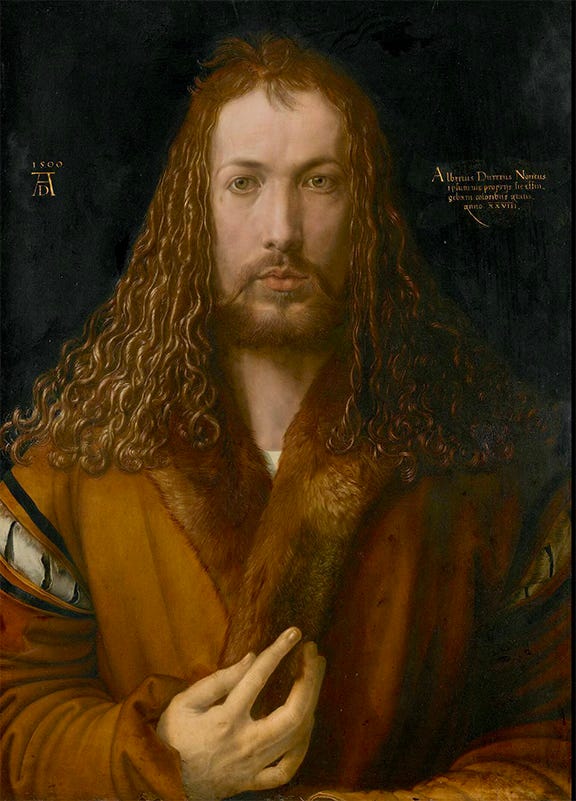
Two years later, Dürer painted Self-Portrait in Furred Coat, or Self-Portrait at 28. This arresting depiction also emphasizes the artist’s handsome features (including rock star hair) and his status; his fur-lined coat with fashionable slashed sleeves may be less outlandish than the black and white ensemble of the earlier portrait, but its refinement also indicates a new self-assurance and economic stability. The artist faces us straight on, his expression somber, his eyes clear and benevolent. This pose with a raised right hand is immediately recognizable as depictions of Christ as Savior of the World (Salvator Mundi); although where Christ’s hand is raised outward in benediction, Dürer’s is pointed toward his heart, a distinctly humanistic gesture. At the right, Dürer has added this inscription: “I, Albrecht Dürer of Nuremberg portrayed myself in appropriate [or everlasting] colors aged twenty-eight years. Egotistical it might be and somewhat controversial, but I don’t see this self-portrait as the artist insinuating that he is divine, but rather that his talents are God-given. Here again, Dürer presents an image that says one thing on its face while offering other, more subjective and complex, interpretations below the surface.
Elisabeth Louise Vigée Le Brun: Mother and Daughter
French painter Elisabeth Louise Vigée Le Brun was one of the most accomplished of the many eighteenth-century female artists in Europe. She received her training from her artist father because, as a girl, she would have been unable to participate in any formal art instruction. Still, she managed to build a modest career by age 15 and, by 20, she was established at the French court, ultimately painting some 30 portraits of Queen Marie Antoinette. When revolution arrived in 1789, Elisabeth fled France with her young daughter, Julie, eager to escape a bad marriage as well the recriminations likely to fall on anyone with royal associations.
In exile, Vigée Le Brun lived from commission to commission. She gradually became something of a celebrity, much sought after for her grand style portraits. Her virtuosic handling of clothing, hair, and skin transformed her subjects into archetypes of neo-classical portraiture. From kings and queens to literary figures and stars of the stage, and aristocrats across Europe and Russia—Catherine the Great was one of her most prominent patrons during the artist’s six years in Russia—Vigée Le Brun was a painter of style and courage.
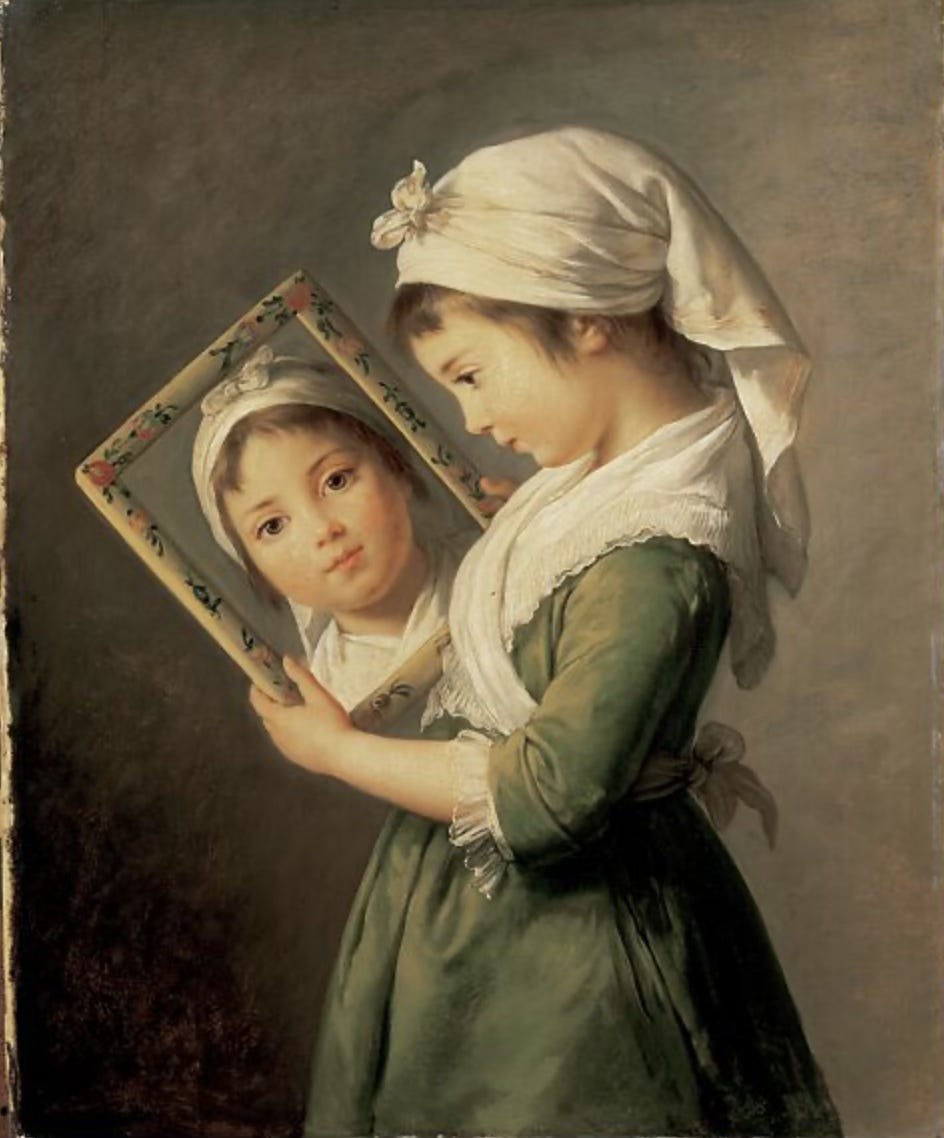
She was also a mother. This charming—and unusual—portrait of the artist’s daughter is handled with Vigée Le Brun’s customary ease. Her post-revolutionary-style clothing is simple and modest, clearly indicating that her mother has broken with the ancien régime. Julie’s face is sweet and slightly idealized but Vigée Le Brun keeps the scene from veering into sentimentality. The neutral background complements Julie’s green dress and white shawl and headscarf, but the frame around the mirror is decorated in delicate pink flowers. Her costume is similar to what would have been everyday wear for a woman of the people, but the mirror and its whimsical frame remind us that Julie is still just a child. Julie stands in profile having tilted the mirror, no doubt at her mother’s instruction, at just the right angle to show her entire face to us. Julie’s gaze is serious (will Mother never finish?) yet we are allowed to share an intimate moment. It is at once an image of motherly devotion as well as a canny sort of calling-card for an artist building a career.
Caspar David Friedrich: Meditation in the Mountains
Wanderer Above the Sea of Fog by Caspar David Friedrich is as recognizable as Leonardo’s Mona Lisa or Munch’s The Scream. A prime example of German Romanticism, it features all the hallmarks of this style: silent contemplation of the sublime in the natural world, man’s willingness to face the unknown, and hints of nationalism. Popular even in the artist’s lifetime, Wanderer may depict a hiker, the artist himself, or Every Man—or all three. As Friedrich once observed “The artist should paint not only what he has in front of him but also what he sees inside himself,” a sentiment that characterizes much of the modern penchant for subjectivity in art.
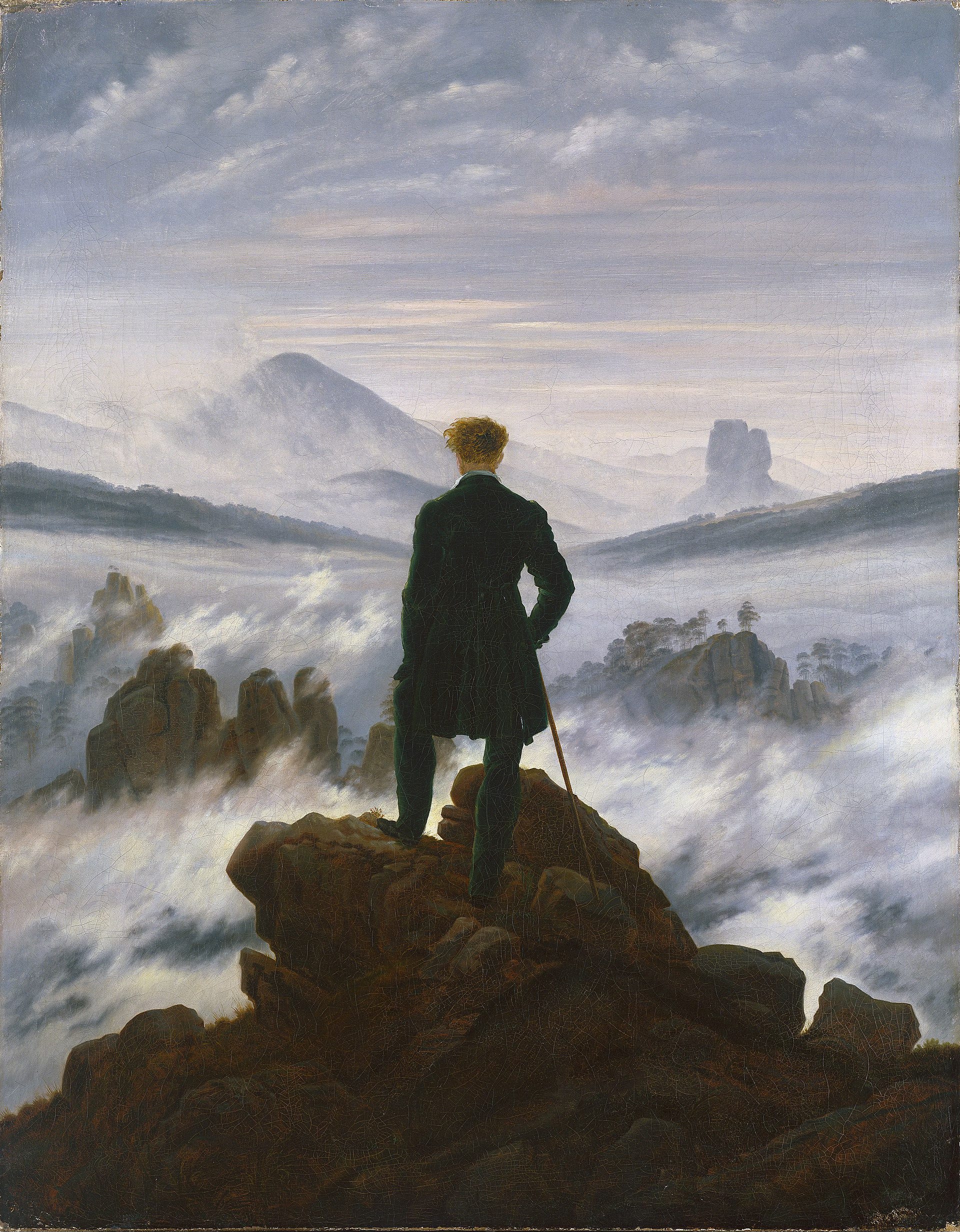
Although this dramatic landscape resembles mountains in Saxony and Bohemia, the scene has been reimagined, the artist enhancing his memories in order to create a certain impression with the painting. Friedrich frequently depicted a person in his work as a Rückenfigur, that is, a figure seen from the back. This has the effect of doubling the sense of contemplation: We see the subject seeing the scene in front of him. Because his back is to us, there is no exchange between the subject and the viewer; the painting’s narrative momentum carries through in only one direction, away from us. What’s more, we the viewer are coming on the subject unawares, perhaps intruding on his meditations. (What if the hiker was startled and fell?) This could be a violation of not only of his personal space but also of his private thoughts.
Friedrich furthers the idea of intimacy and ambivalence by encouraging us to join the hiker in an appreciation of the landscape, one, let us remember, that is compromised in the sense that it is the product of an imaginary recreation and not a faithful reproduction of a known place. (Of course, we don’t have to recognize a place to enjoy a representation of it.) The exhilaration of the sublime landscape is tempered then by a sense of distrust, intensified by this fellow with his back to us. Friedrich renders this mix of objective beauty and subjective interiority in a style that is highly finished, dramatic, and intense. (The influence of his time in the Netherlands studying the Dutch masters is clear here.) Sadly, Friedrich’s work became almost completely unknown after his death and, in the 1930s, it was picked up by the Nazis as representing heroic Germanic ideals of “blood and soil.” But his reputation is once again on the upswing and, if you are fortunate enough to be in New York, you can see a major exhibition of his work at the Metropolitan Museum through May 11.
I hope you will return next week for part two in which I will look at three more examples of self-portraits and portraits of the self: A Bar at the Folies-Bergère, Édouard Manet’s final masterpiece, Broken Column by Frida Kahlo, and an unusual self-portrait by Lucian Freud.