
Defining the Surface
Vickie Vainionpää’s “Soft Logic” at Gainesboro Modern

Frank Stella has said that the problem of painting never changes: “You have a surface which you need to define.” Canadian painter Vickie Vainionpää defines painting as a joint effort of “intellectual collaborators across time and space.” These collaborators might be human and they might be algorithms. Across the generations and across technologies, says Vainionpää, the conversation is one in which the gap between experience and perception is never bridged—or is it? Using technologies such as 3D software, virtual reality, eye-tracking, and generative algorithms, Vainionpää proposes to close the gap between the experience of seeing and the practice of translating that experience into one expressed by canvas and paint. She is asking us, in short, to consider the future of art.
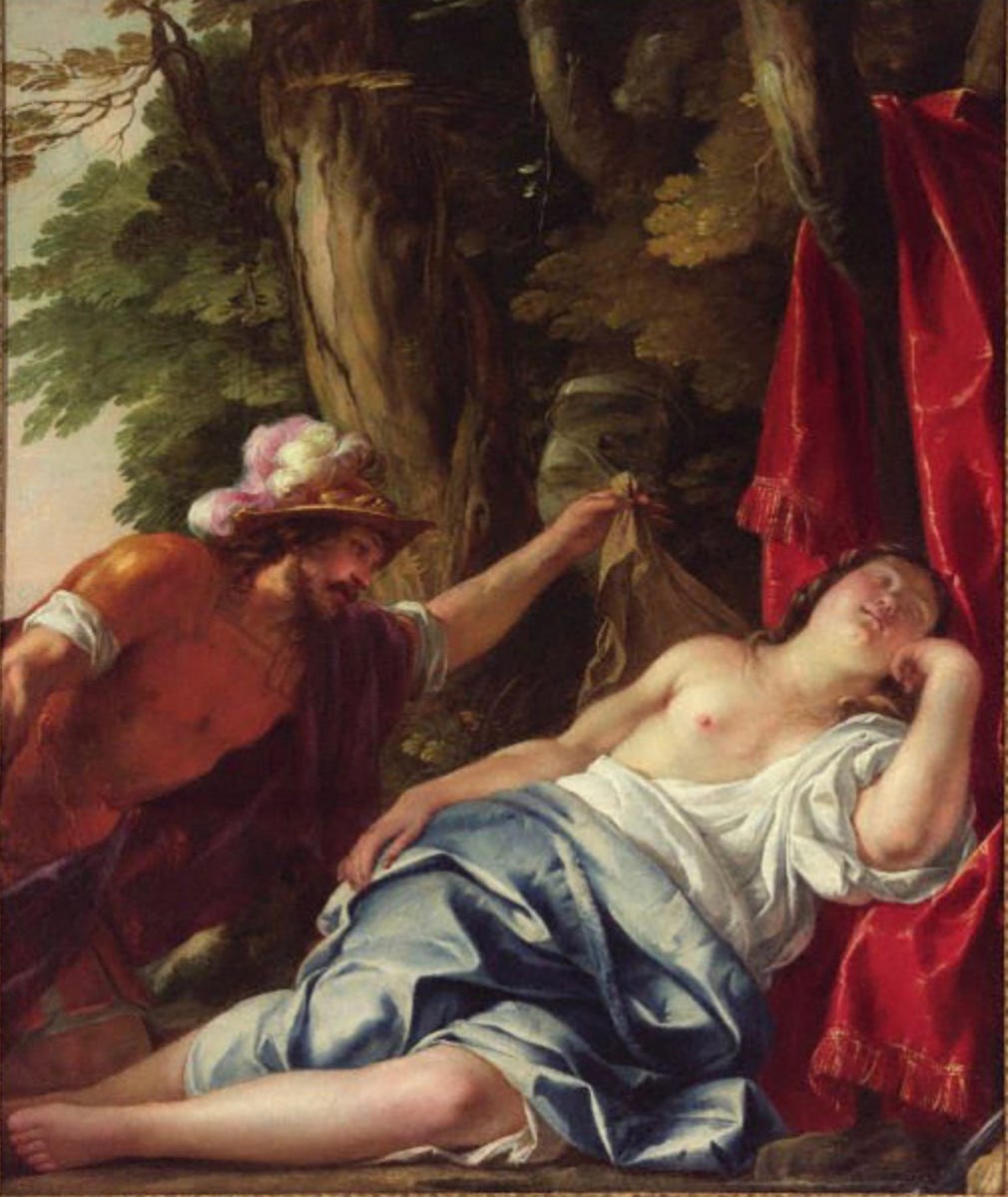
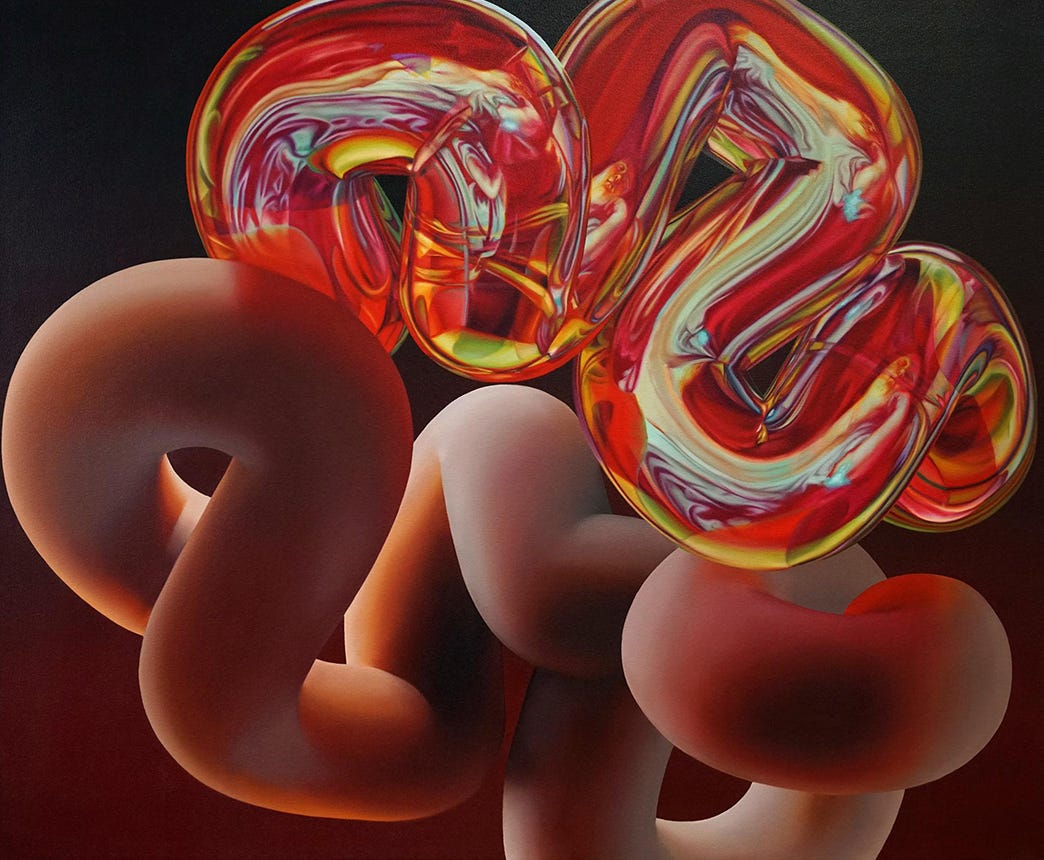
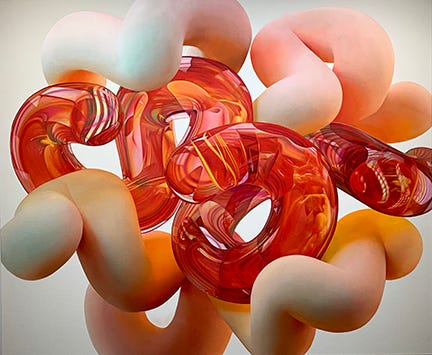
One way Vainionpää’s work changes the experience of art is by experiencing it first hand, which I did recently at the new exhibition Soft Logic at the Gainesboro Modern Museum of Contemporary Art. The works in the Soft Body Dynamics series are exuberant and kinetic, tight balls of wiggles, some in flat color, delicately modeled, some painted like reflective glass or chrome. The surfaces of the paintings are smooth, strangely uninflected—any sign of the hand of the artist has been removed. For works in the Gaze series, the artist wore an eye-tracking device and recorded how her eye traveled over works such as Tintoretto’s The Origin of the Milky Way and Jacques Blanchard’s Mars and the Vestal Virgin. The idea is to transform the physical pathways of the eye into abstract compositions, “shifting attention toward the act of looking itself.” The wiggles, which Vainionpää calls “random curves,” were “based on a plug-in that generates random curves in 3D software.”
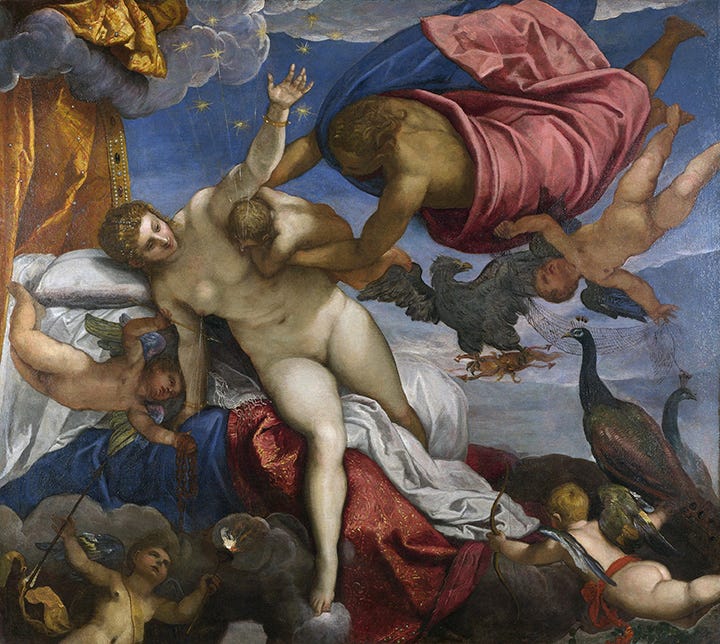
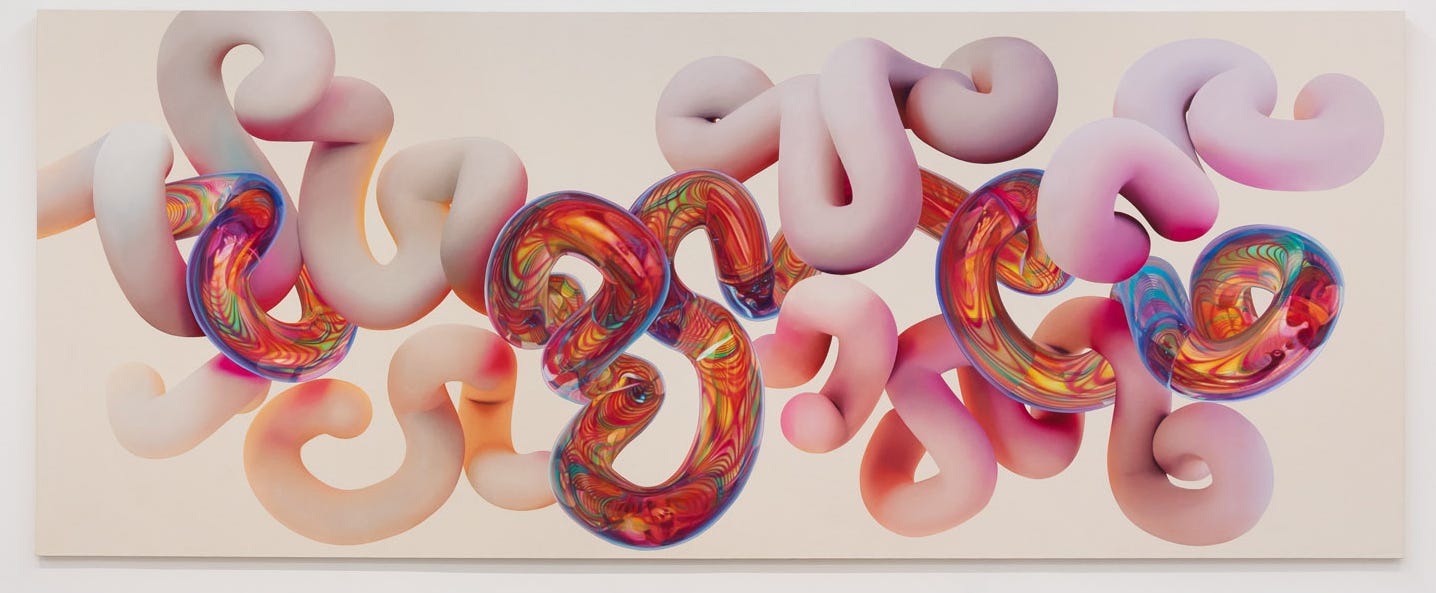
In The Origin of the Milky Way, where Tintoretto ends and Vainionpää begins is left open. Unlike many of her other works, Milky Way mixes wiggles in one color with those in full color, the eye-tracked curves blending together instead of separating into distinct areas. Where, in the Tintoretto, the artist draws our eye with the strong diagonals of Jupiter pressing Hercules to Juno’s breast, Vainionpää focuses instead on the putti and peacock at the margins of the canvas. The voluptuous curves and colors of Tintoretto’s Venetian mannerism are recast in a more literal exploration based on eye-tracking, not only that of the artist in creating the painting but (in real time) that of the viewer in looking at it. Any connection with mythology or symbolism is leached out of the work into a flattened exchange of painterly effects presented and received.
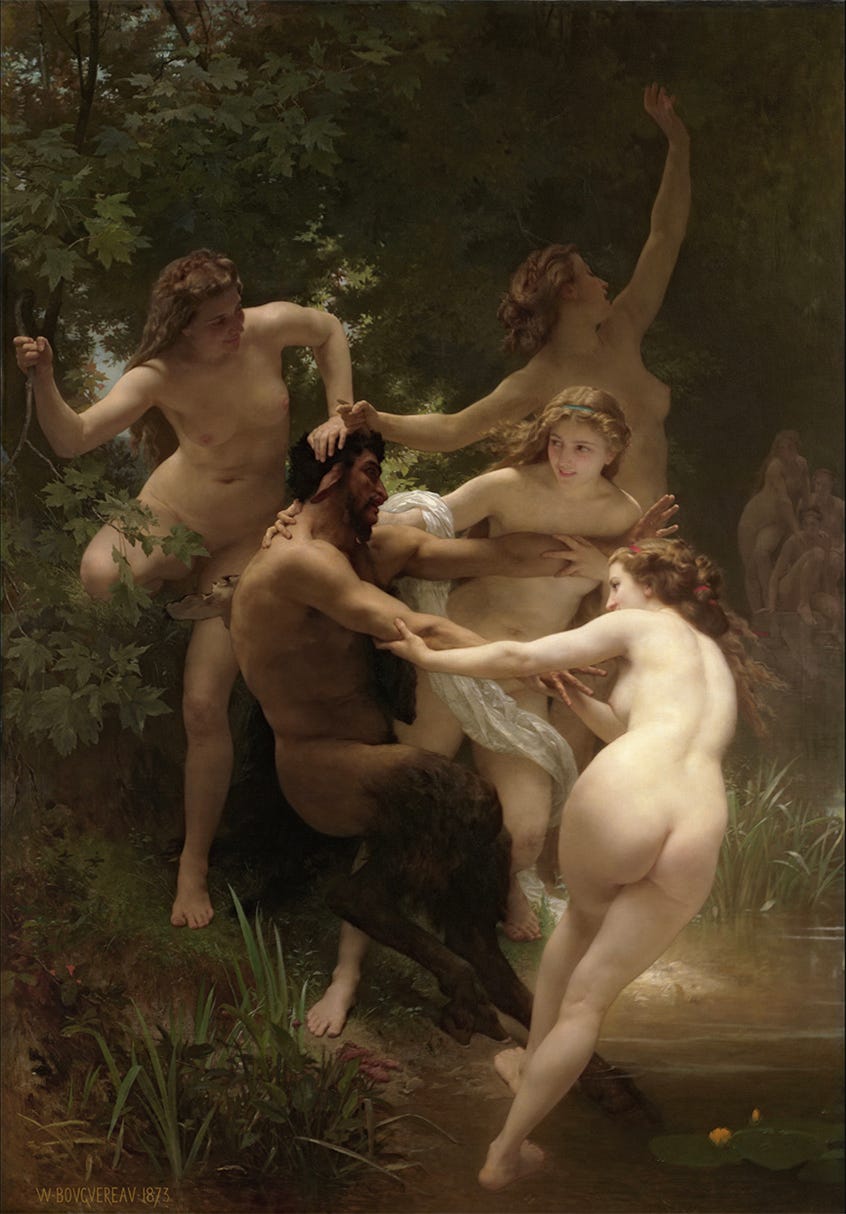
Up close with Roman Landscape with Nymphs, we see in its mirror-like bulges streaks of what appear to be sky, ground, a nude hip, and the back of a figure raising his right arm. (Here, it has proven more difficult to discover the original painting that inspired Vainionpää.) Mars and the Vestal Virgin offers the squiggles on a black background, the chrome-like twists inspired by Jacques Blanchard’s 1637 painting of the god of war discovering a sleeping nymph. The shiny surfaces echo Mars’s armor and helmet while the shadowy, flesh tones of the one-color squiggles suggest the virgin’s exposed breast and white robe. Nymphs and Satyr appears to have been inspired by William-Adolphe Bouguereau’s 1873 painting of the same name. Bouguereau has his detractors but there is no doubt the man could paint—his facility with glowing light touching satiny skin is almost unmatched. Vainionpää’s work recalls the fulsome nudity and sensual curves of Bouguereau’s depiction of a satyr overmatched by four mischievous nymphs, while her smoothly polished surface allows the eye to glide effortlessly over the image. It is just this kind of unquestioning roving eye that has launched generations of feminist critics incensed over the male gaze.
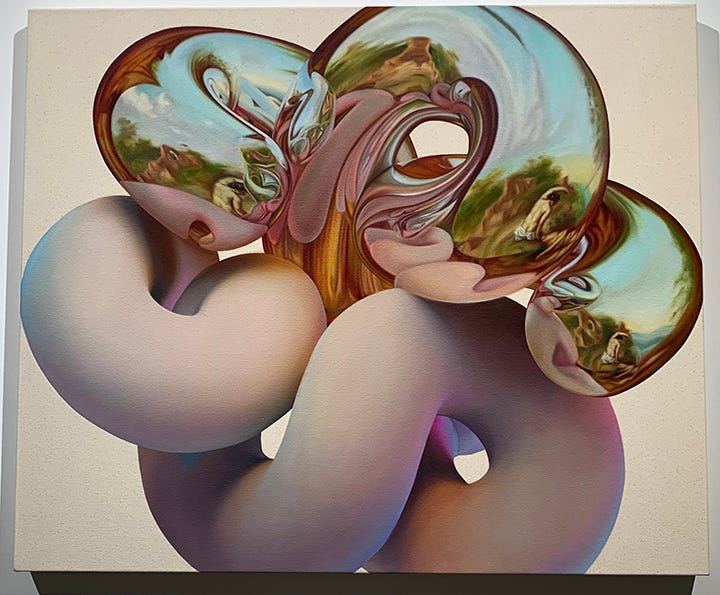
Vainionpää’s work is dynamic yet static, its squiggles roiling and undulating with vague unpleasantness. More disturbing is the prominence of digital tools in the generation of the work. At the same time, there are unexpected elements of continuity with the past. Her skewed and twisted renderings draw on painting effects such as concave/convex distortions, the camera obscura, and anamorphosis. Artists such as Canaletto and Joshua Reynolds employed the camera obscura for painting and there has been much written about whether or not Vermeer did as well. Jan van Eyck’s remarkable Arnolfini Portrait (1434) includes a convex mirror that reflects and distorts the scene. The best known example of anamorphosis is Hans Holbein’s Renaissance masterpiece The Ambassadors (1533), a portrait of two French diplomats surrounded by an array of objects. The painting is a virtuosic display of materials, textures, colors, and symbolism. As if this were not impressive enough, Holbein added a memento mori, a reminder of mortality, in the form of a giant skull, only discernible as a skull if the work is viewed from the lower right. Straight on, the skull just looks like a diagonal gray slash. And, of course, Vainionpää’s interest in chance, automatism, and the unconscious mind place her work among that of the Surrealists. It could be argued that Vainionpää’s use of tools such as virtual reality and algorithms is in line with artists’ perennial search for ways to bring three dimensions into a two-dimensional medium.
Vainionpää’s penchant for the pneumatic brings to mind French artist Fernand Léger’s “mechanical period” (1918–1923) during which the artist used a set of shapes—the cone, the cylinder, the disk—to evoke the idea of the machine. Léger’s works from this time look vaguely like machinery but were more decorative than realistic. Léger, at that time in his Cubist phase, was painting forms that suggested modern architecture, modern music, and fast cars and trains. In some of his works, the shapes are flat, while in other paintings, modeling—of shapes and people—gives them the quality of being puffy or pneumatic. The point is that Léger was more interested in the notion of the machine, the suggestion of modernity. Likewise, Vainionpää suggests in her pursuit of digitally enhanced painting an experience of an epoch in which technology shapes human life to such a degree that we become more interested in the technology than in our own humanness.
Vainionpää’s writings are almost as freeform and roving as her work, incorporating a stream-of-consciousness blend of languages, philosophy, science fiction, and medicine. She returns often to ideas akin to transhumanism with its aspirations to live longer and better through science and technology. As Vainionpää sees it, the exigencies of reality and the promises of technology place us, in the words of American artist Joseph Nechvatal, in: “the ‘viractual’ which strives to create an interface between the biological and the virtual. Nechvatal suggests that the term may be helpful in defining our now third-fused inter-spatiality which is forged from the meeting of the virtual and the actual.” This in-betweenness—“Zwischendingen, a conflation of the German word for ‘between’ and ‘things’”—may be disorienting and a cause for fear. But for Vainionpää, embracing this in-betweenness is a source of optimism and joy. This is the “soft logic,” so to speak, that propels Vainionpää’s art toward the future. Whether it is a future of random curves or straight lines is something that is impenetrable to even the most cunning of bots.